
Working indoors doesn’t make sex work safe by default. Too many people assume that being behind a locked door is enough. It’s not. The real safety comes from knowing your space inside and out-before a client walks in. You need to spot the traps, map the exits, and trust your gut before you even say hello.
Screening the Environment Before You Say Yes
Don’t let a good vibe or a high rate blind you. The first thing to check isn’t the bed, the lighting, or even the cleanliness. It’s the layout. Walk in with your eyes open and your phone charged. Look for:
- Multiple doors or windows that can be opened from the inside
- Locks that work without a key-deadbolts, chain locks, smart locks with auto-lock
- Blinds or curtains that can be closed without leaving the room
- No mirrors that face the entrance or bed
- Clear sightlines from the entrance to every exit
One worker in Melbourne told me she turned down a $1,200 booking because the apartment had only one exit-a narrow hallway with a door that jammed when she tested it. She called it a "death trap" and was right. That same place was later raided for illegal activity. You don’t need to be a detective, but you do need to be suspicious.
Ask yourself: if something went wrong right now, could I get out in under 10 seconds? If the answer isn’t a clear yes, walk out. No client is worth your life.
Emergency Exits Are Not Optional
Most people think of emergency exits as fire codes or building regulations. For you, they’re survival tools. Every room you work in must have at least two ways out. One is the front door. The second? That’s where most people fail.
Look for:
- Windows that open wide enough to climb through (even if you’re not small)
- Fire escapes, balconies, or rooftops that connect to other buildings
- Back doors, service entrances, or laundry room exits
- Loose floorboards or ceiling panels that could be used as hidden access points
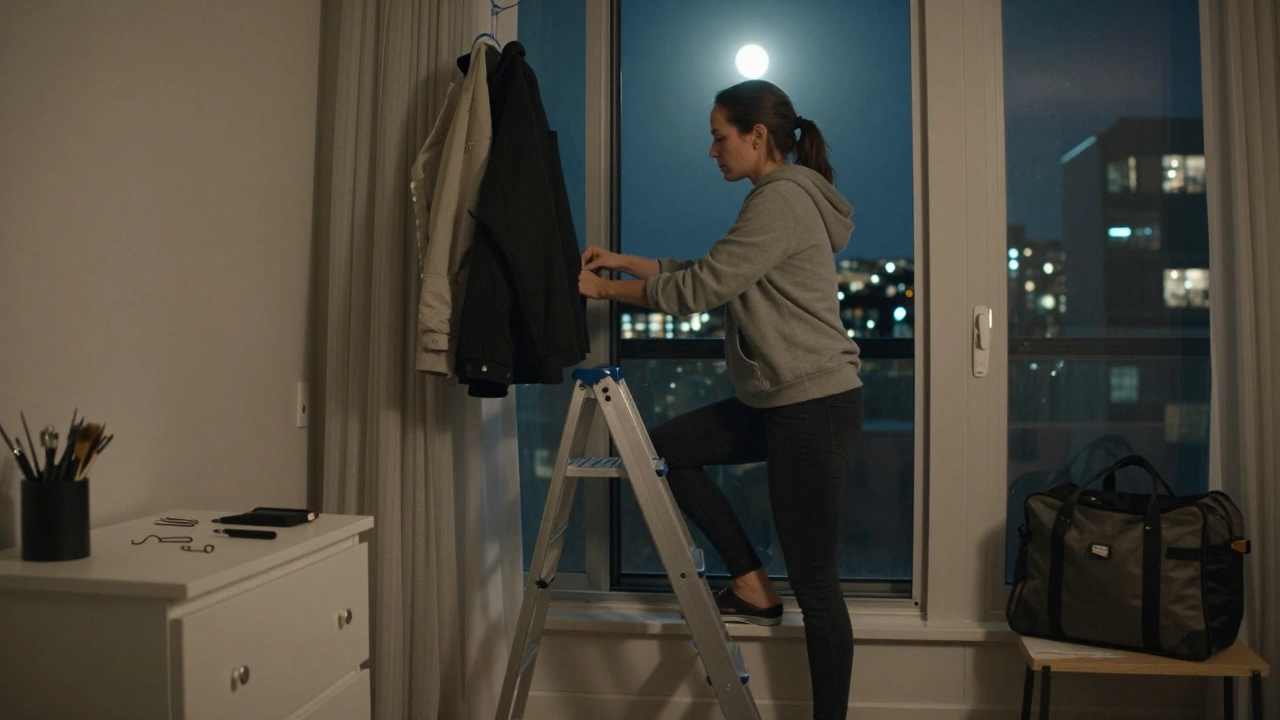
One worker in Sydney kept a small folding ladder in her closet. It fit behind a hanging coat and led to a flat roof next door. She used it twice-once to escape a violent client, once to avoid a police raid. She didn’t tell anyone. She didn’t need to. It worked.
Don’t rely on phones alone. Batteries die. Signals drop. If you’re stuck in a room with no way out, your phone is just a brick. Your body is your last tool. Train yourself to move fast. Practice opening windows, unlatching locks, and moving quietly. Do it when you’re calm. That’s the only time your muscles will remember.
Technology as a Backup, Not a Shield
Apps like Redbook, Whispa, or safety check-in tools are helpful-but they’re not magic. They don’t stop someone from breaking down your door. They don’t call the cops for you if you’re silenced.
Use them right:
- Set a timer for your session. If you don’t check in by the end, your safety contact gets an alert
- Share your location with one trusted person before the client arrives
- Use a decoy phone number for clients. Never give out your real one
- Record audio in the background if your phone allows it (check local laws)
One worker in Brisbane used a smart plug connected to her phone. She turned it on when a client arrived. If she didn’t turn it off within 90 minutes, her friend got a text: "Something’s wrong." That simple system saved her from a man who tried to strangle her. She didn’t scream. She didn’t fight. She just let the timer run out.
Technology helps. But it’s a backup. Your eyes, your instincts, your exits-they’re the frontline.
Red Flags You Can’t Ignore
Some signs are obvious. Others? They hide in plain sight.
- The client insists on paying in cash only-no digital trail
- They bring a friend "just to hang out"
- They ask you to turn off your lights or cover the windows
- They seem overly interested in your movements or where you live
- The place smells like smoke, bleach, or alcohol-odd for a clean rental
- You hear voices or footsteps outside that don’t belong
One worker in Perth had a client who kept asking about the building’s fire alarm. She thought it was weird but didn’t say anything. Later, she found out he was a private investigator for a brothel operator trying to identify independent workers. He wasn’t there for sex. He was there to gather intel.
If something feels off, it probably is. Don’t rationalize it. Don’t say, "I’ve been fine before." That’s how people get hurt. Trust your body. Your stomach tightens. Your breath gets shallow. Your hands get cold. That’s your alarm system. Listen to it.
What to Do If You Feel Trapped
There’s no script for panic. But there are actions that work.
- Stay calm. Speak slowly. Say, "I need to call my sister." Then reach for your phone. If they try to stop you, say, "I’m calling the police." Most won’t risk it.
- If you’re locked in, bang on the door and yell for help. People hear more than you think. Neighbors, cleaners, delivery people-they’re often closer than you assume.
- If you have a phone, text your safety contact: "I need help. Location: [address]." Even if you can’t speak, a text can be traced.
- If you’re being physically attacked, fight dirty. Eyes, throat, groin. Don’t worry about being polite. You’re not in a movie. You’re fighting for your life.
One worker in Adelaide used a hairpin to jam the lock on her door during a bad encounter. She didn’t have a key. But the pin bent just enough to stop the latch from catching. She pushed the door open, ran down the stairs, and flagged down a taxi. No one saw her run. But the taxi driver noticed her shaking. He asked if she was okay. She said yes. He drove her to a 24-hour pharmacy and waited while she called the police.
You don’t need to be brave. You just need to be ready.

Building a Safety Network
Working alone doesn’t mean working isolated. The most dangerous thing isn’t the client-it’s believing you have to handle everything yourself.
Build your network:
- Find one or two trusted workers you can text at the start and end of every shift
- Join local peer-led safety groups. Many cities have WhatsApp or Signal groups for sex workers
- Know the numbers of local harm reduction organizations. In Perth, the SWOP team responds within 20 minutes if you call for help
- Keep a printed list of emergency contacts taped inside your bag or hidden in your shoe
One group in Melbourne started a code word system: "I’m having a bad day" means "I need you to call the cops." "I’m running late" means "I’m stuck and need backup." They’ve used it five times in two years. No one got hurt.
You’re not weak for asking for help. You’re smart.
It’s Not About Fear. It’s About Control.
Safety isn’t about living in fear. It’s about taking back control. You decide who walks in. You decide when they leave. You decide how to get out.
Every room you work in should feel like your space-not theirs. That means knowing where everything is. Where the lights are. Where the exits are. Where your phone is. Where your bag is. Where your keys are.
Practice makes permanent. Walk through your space every time you enter. Even if you’ve been there ten times. Even if it’s the same building. Because the next time, it might not be.
You deserve to work without fear. Not because the world is fair. But because you’ve earned it.
What’s the most important thing to check in a new work environment?
The number and accessibility of exits. Always test at least two ways out-doors and windows. If you can’t escape quickly, you’re at risk. No client, no payment, no promise is worth being trapped.
Can I use a smart lock for safety?
Yes-but only if it has a manual override and doesn’t lock you in. Some smart locks auto-lock from the inside, which can be deadly. Always test it before a client arrives. Make sure you can unlock it from the inside without a phone or code.
What if I’m in a place with no windows?
Avoid it. If you’re already there, know the building layout. Is there a fire escape? A service corridor? A neighbor’s balcony? If not, leave immediately. A room with no windows is a death trap. No exceptions.
Should I carry pepper spray or a personal alarm?
It depends on your local laws. In Australia, pepper spray is illegal for civilians. A loud personal alarm that triggers a siren can work-but only if you’re willing to use it. Practice pulling it out and activating it. If you hesitate, it won’t help. Your voice and your ability to run are your best weapons.
How do I know if a client is dangerous before they arrive?
Look for red flags in messages: pressure to meet quickly, refusal to show ID, asking for private locations, insisting on cash-only, or asking you to turn off cameras. If they avoid video calls or give vague details about the location, walk away. Most predators avoid transparency.
What should I do if the police arrive unexpectedly?
Stay calm. Don’t run. Don’t resist. Ask if you’re under arrest. If they say no, you can ask to leave. If they say yes, ask for a lawyer. Keep your hands visible. Don’t reach for your phone or bag unless they tell you to. Most raids are about location, not you. Your safety comes from staying still and speaking clearly.
Next Steps: Build Your Safety Plan Today
Don’t wait for something to go wrong. Right now, take five minutes:
- Write down your three most common work locations
- For each one, list two emergency exits
- Test one exit right now-open the window, unlock the door, feel the latch
- Text one trusted person: "I’m updating my safety plan. I’ll check in after my next shift."
- Save the number of your local sex worker support group in your phone under a fake name
Safety isn’t a one-time thing. It’s a habit. The more you practice it, the less you have to think about it. And when the moment comes-you’ll already know what to do.